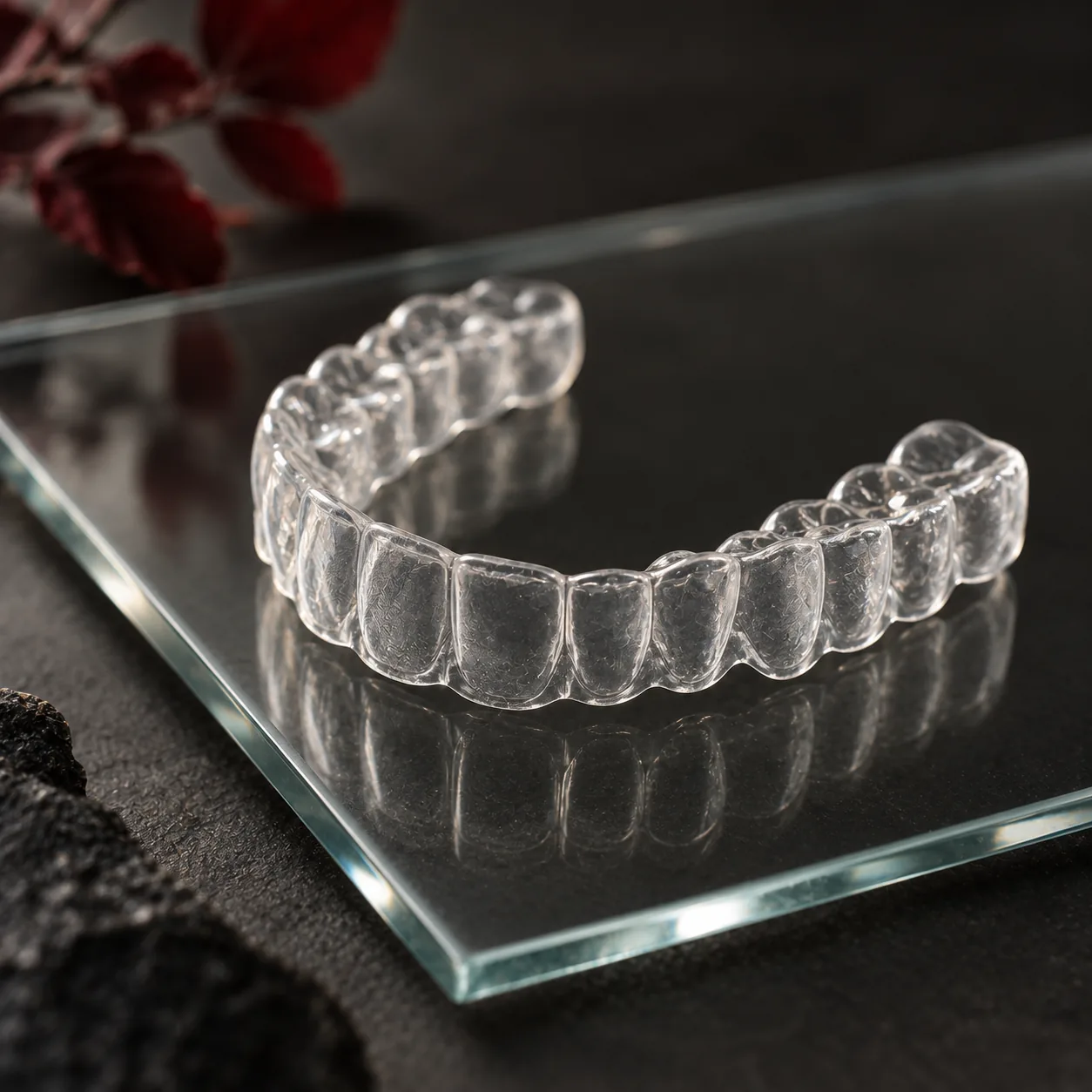
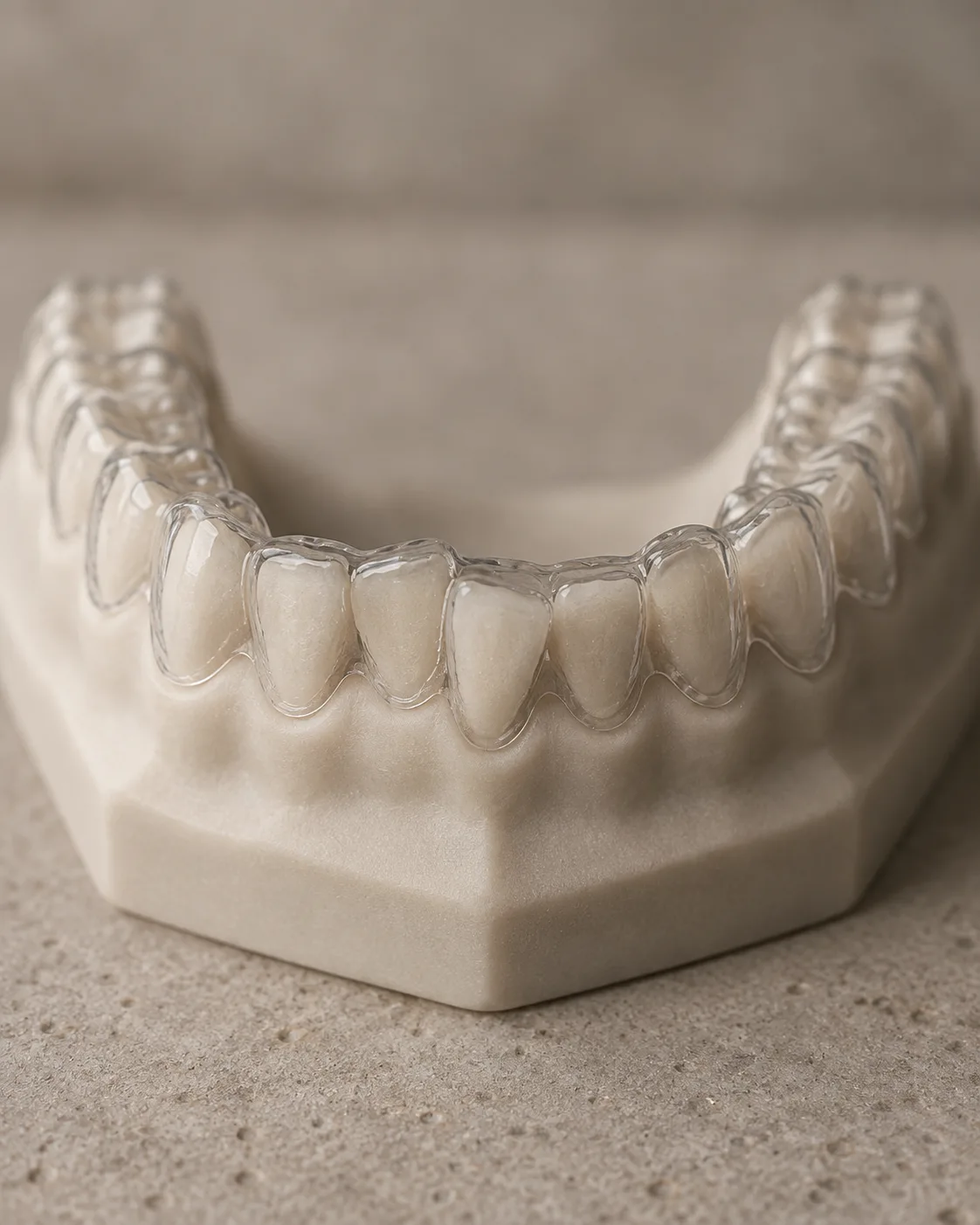
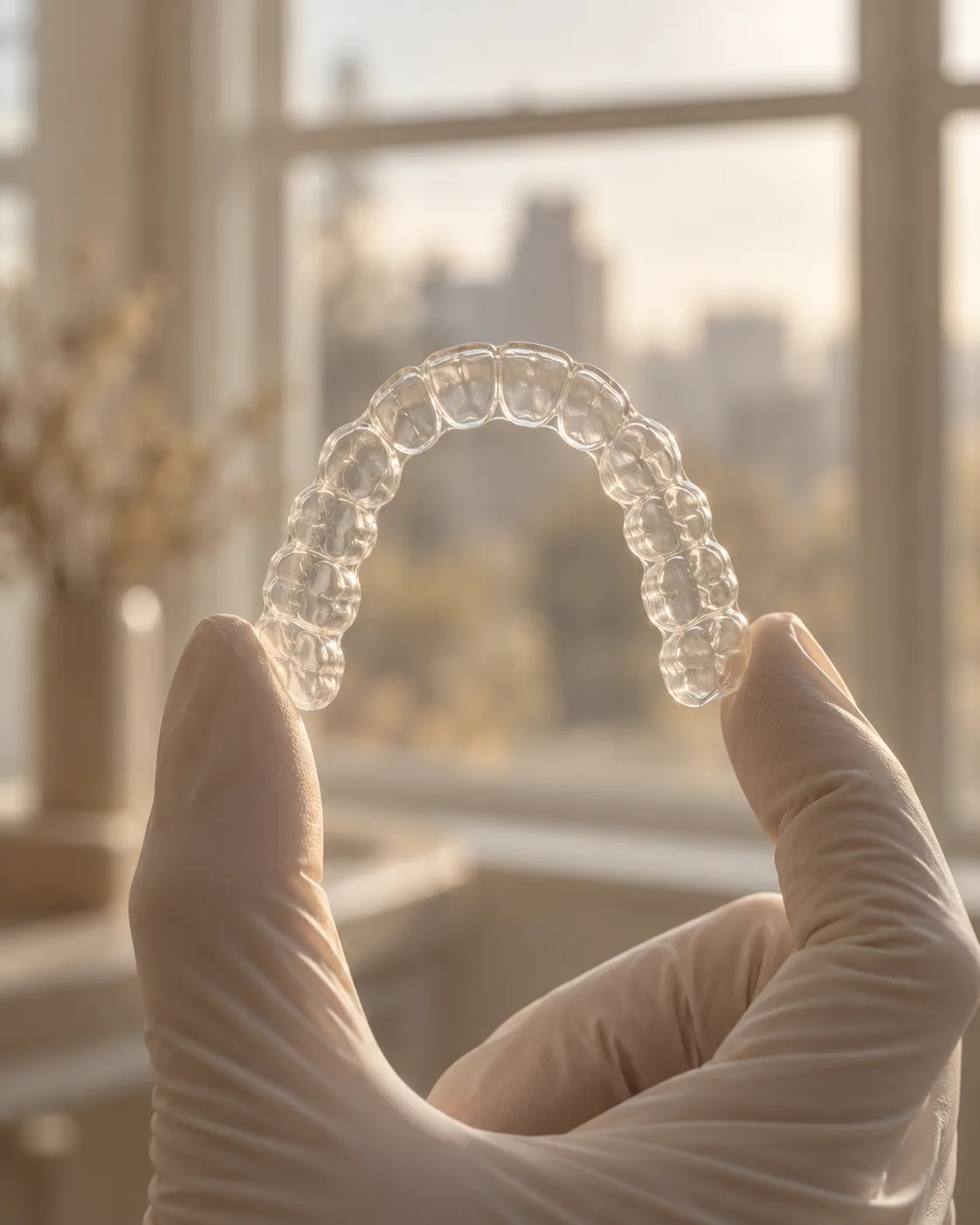
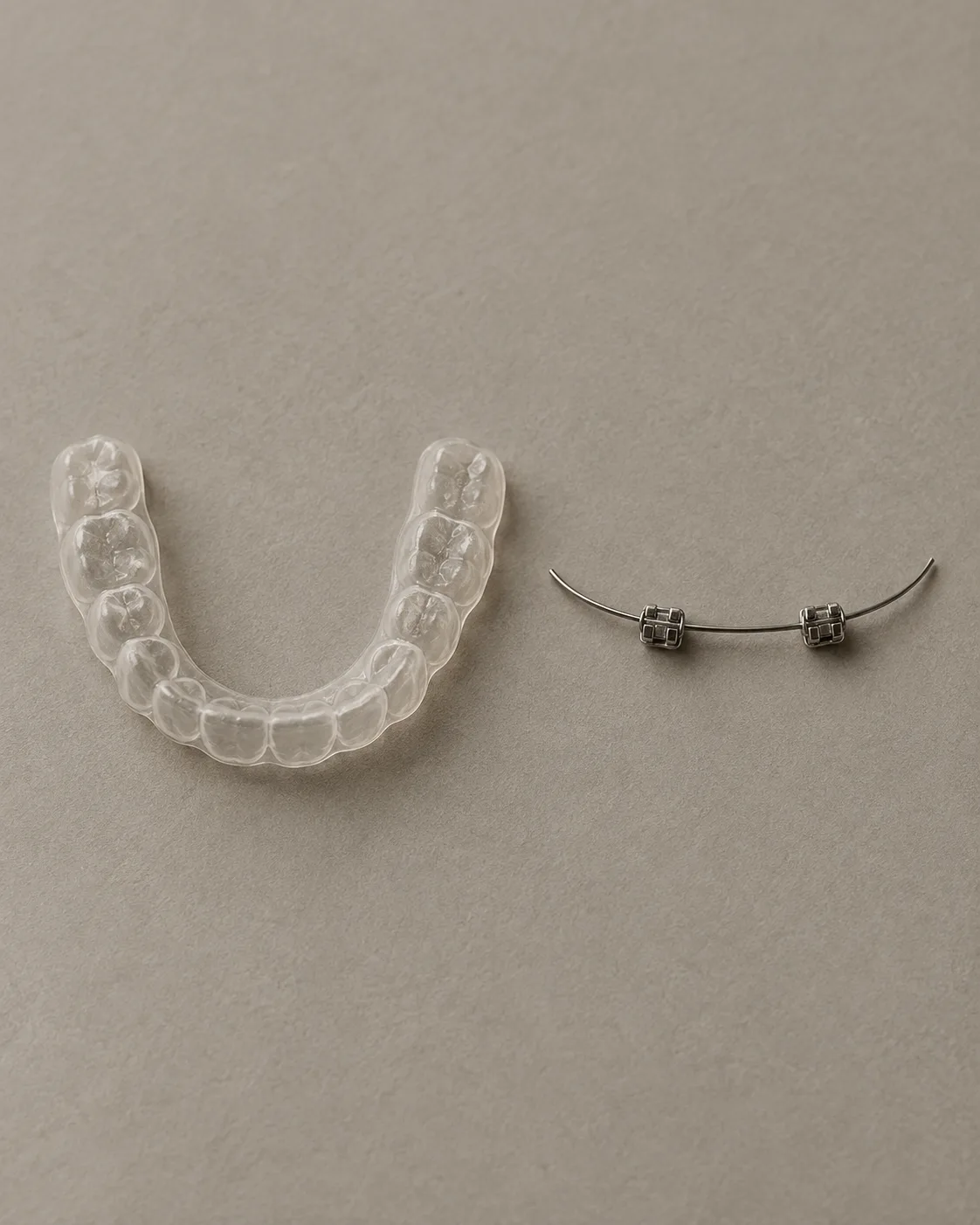
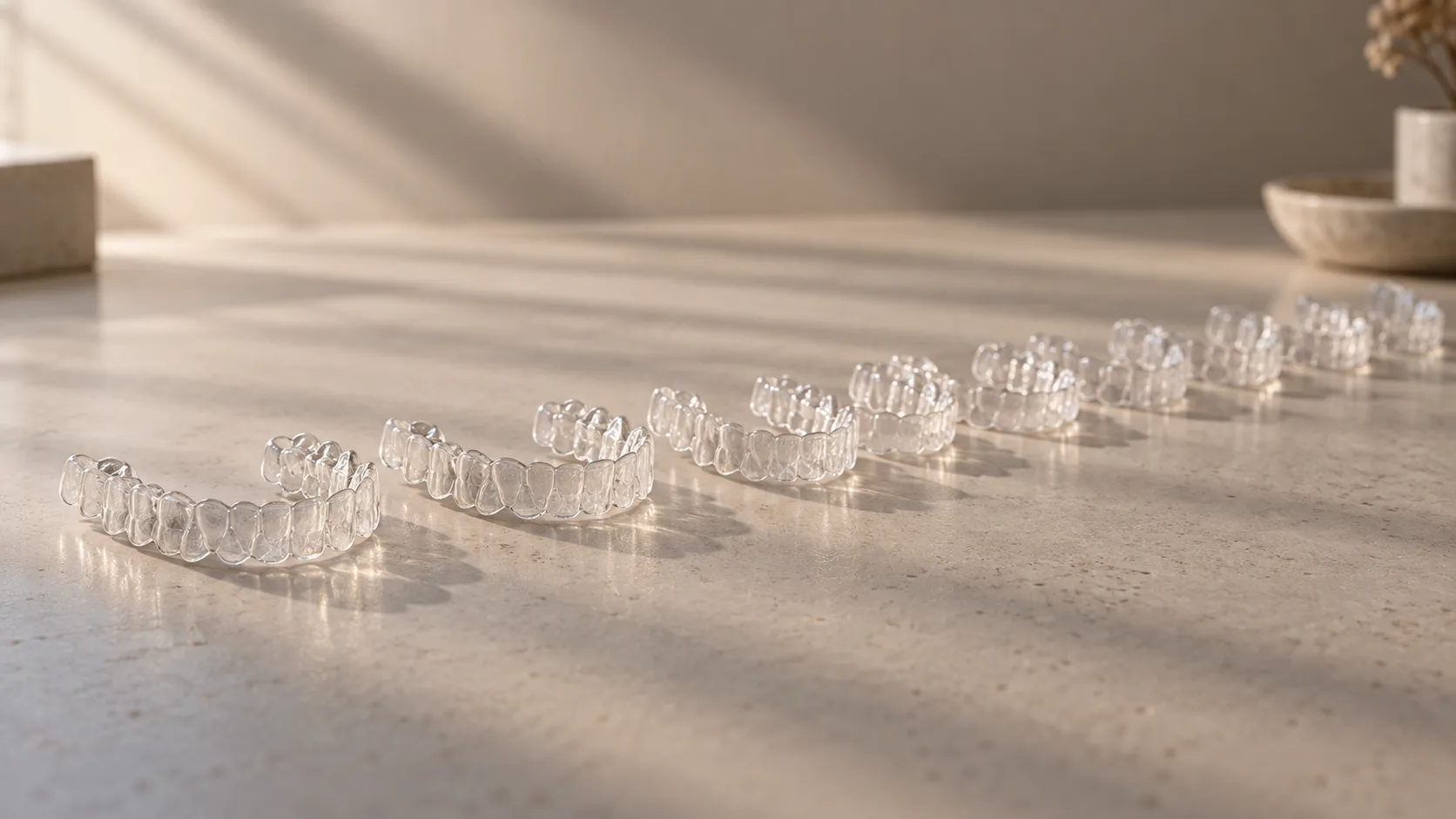
Clear aligners are a series of thin transparent trays, each one shaped slightly differently from the last. You wear each for a week or two and the teeth move a fraction at a time until they are where the plan says they should be.
Clear aligners are a series of thin transparent trays, each one shaped slightly differently from the last. You wear each for a week or two and the teeth move a fraction at a time until they are where the plan says they should be.
The short answer. Aligners straighten teeth without brackets or wires. They are removable, nearly invisible, and they only work for the hours they are actually in your mouth - 20 to 22 a day. Cases run from a few months to about eighteen.
The trays are made from a scan of your mouth, so the whole course is planned before the first one goes in. That is also why discipline matters: skip wear time and the teeth fall behind the trays, and the sequence stops fitting.
02
What aligners can and cannot straighten
They handle crowding, spacing, mild to moderate rotations and the relapse that shows up years after teenage braces - which is the most common reason adults ask about them.
They are not the answer for severe skeletal discrepancies, large bite corrections or teeth needing significant vertical movement. Those want fixed braces or, occasionally, surgery, and any provider claiming otherwise is stretching the technology to fit the sale.
Straightening before cosmetic work is usually the less destructive order: moving a crooked tooth costs no enamel, while veneering it to look straight costs some permanently.
03
Your Aligner Journey in 6 Steps
A clear path to a straighter smile. From your digital scan to your final retainer.
01Assess
Consultation & Digital Records
We take photos, digital scans, and X-rays if needed. We check your bite and gum health and discuss your smile goals in detail.
02Design
Planning & Consent
We design your case and show a clear plan: estimated aligner count, attachments, any IPR (tiny polishing for space), and timelines. You get costs and a retention plan in writing.
03Start
Fitting & First Wear
We fit the first aligners, place attachments (small tooth-coloured bumps) if required, and do IPR where planned. We teach you wear time, cleaning, and switch days.
04Progress
Wear & Review
You wear aligners 20–22 hours daily and switch sets every 1–2 weeks. Reviews are in clinic or remote, depending on your case. We track fit and progress meticulously.
05Tweak
Refinements (if needed)
Small plan tweaks are common for precision. We add a short refinement set if certain teeth need extra movement to reach perfection.
06Retain
Finish & Retainers
When we reach the goal, we fit retainers to hold the result. Options include fixed (bonded) wires, clear removable retainers, or both. You get a simple wear schedule.
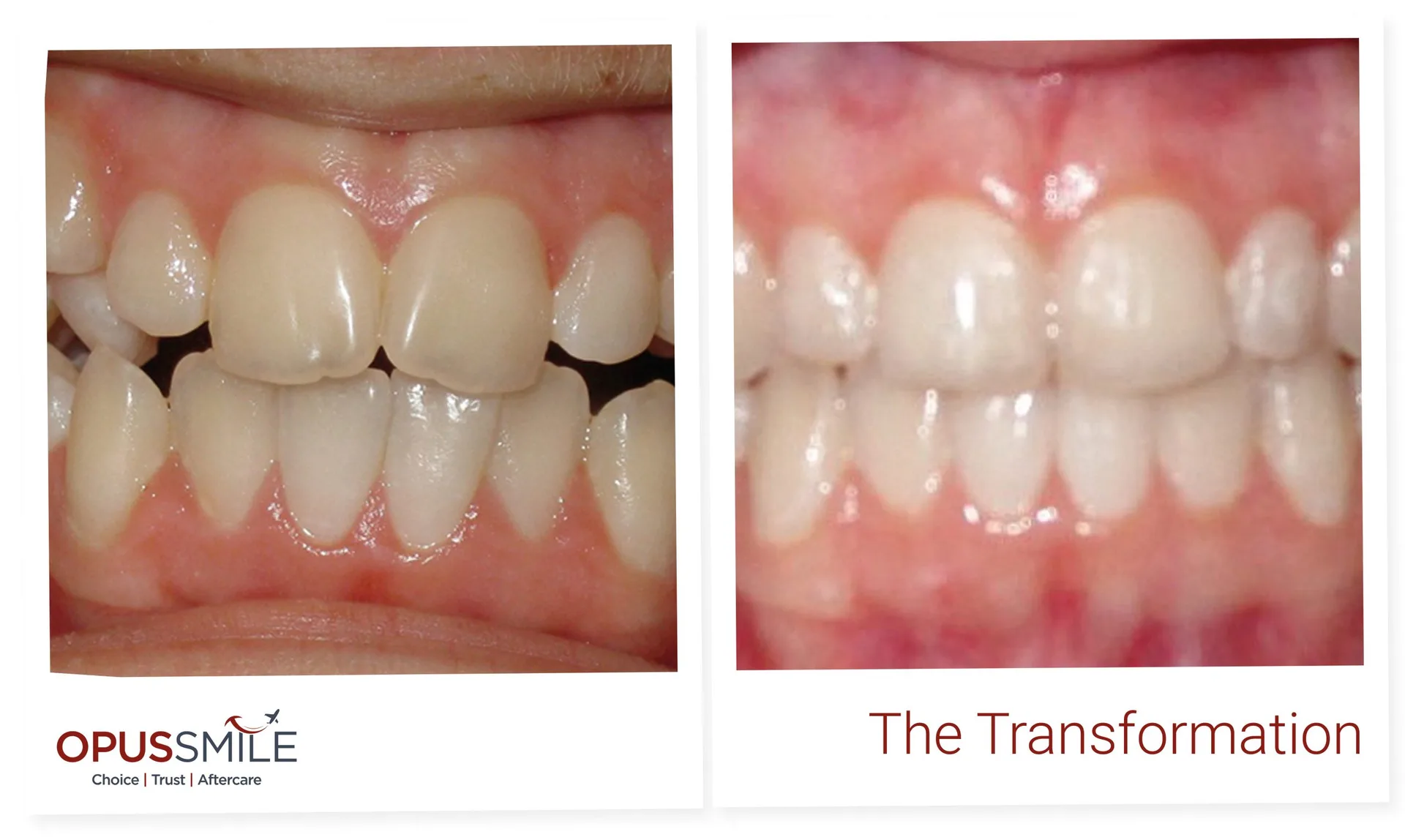
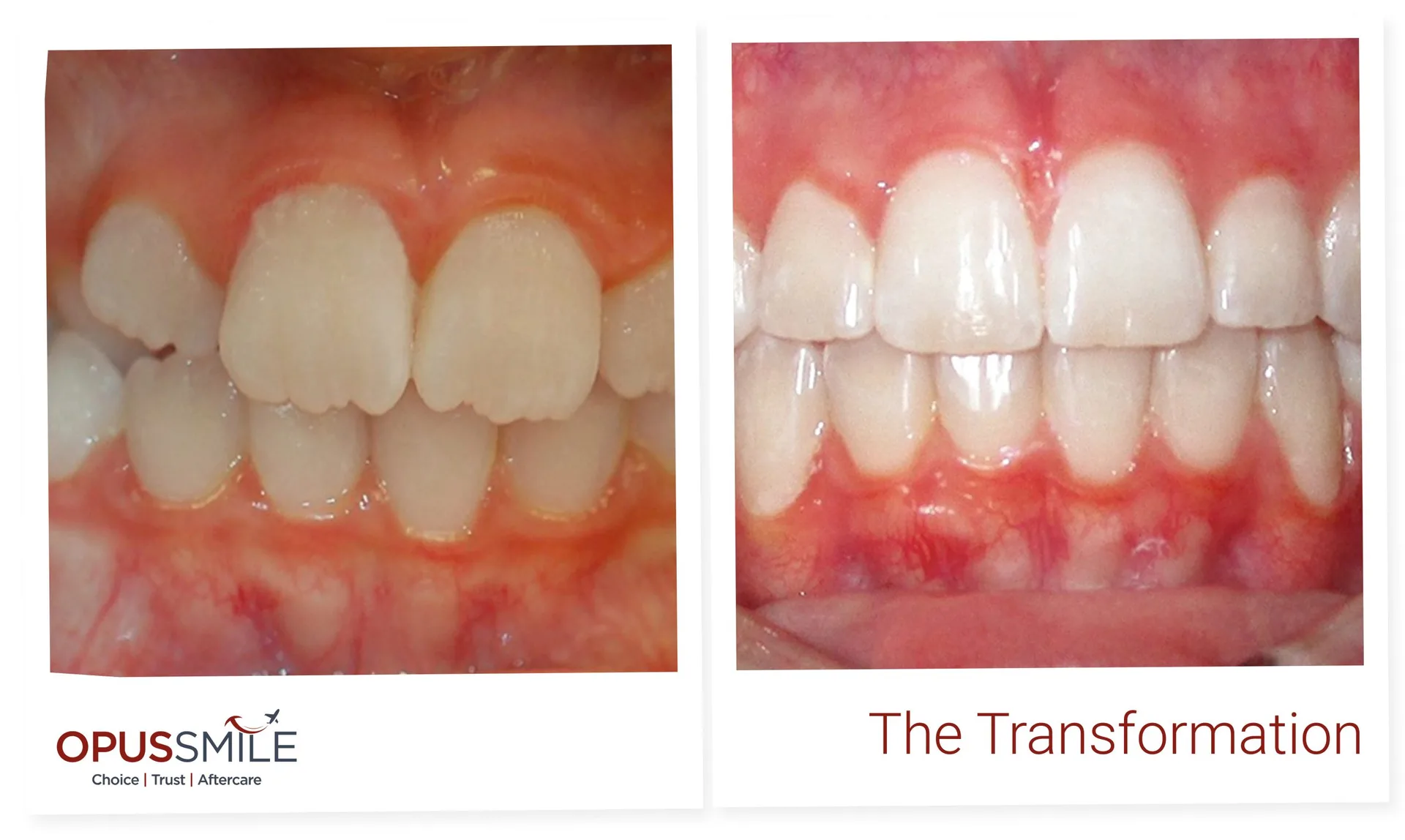
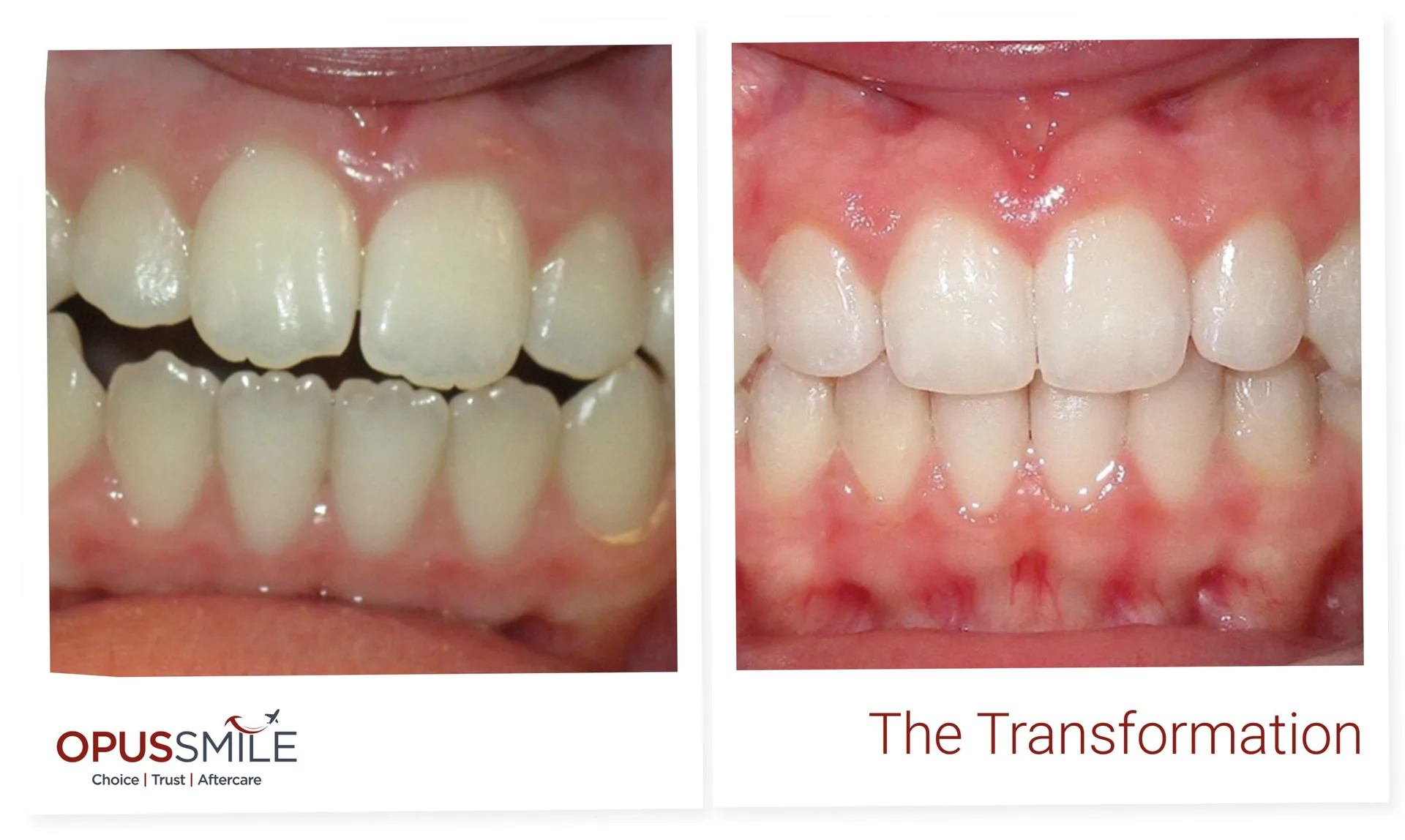
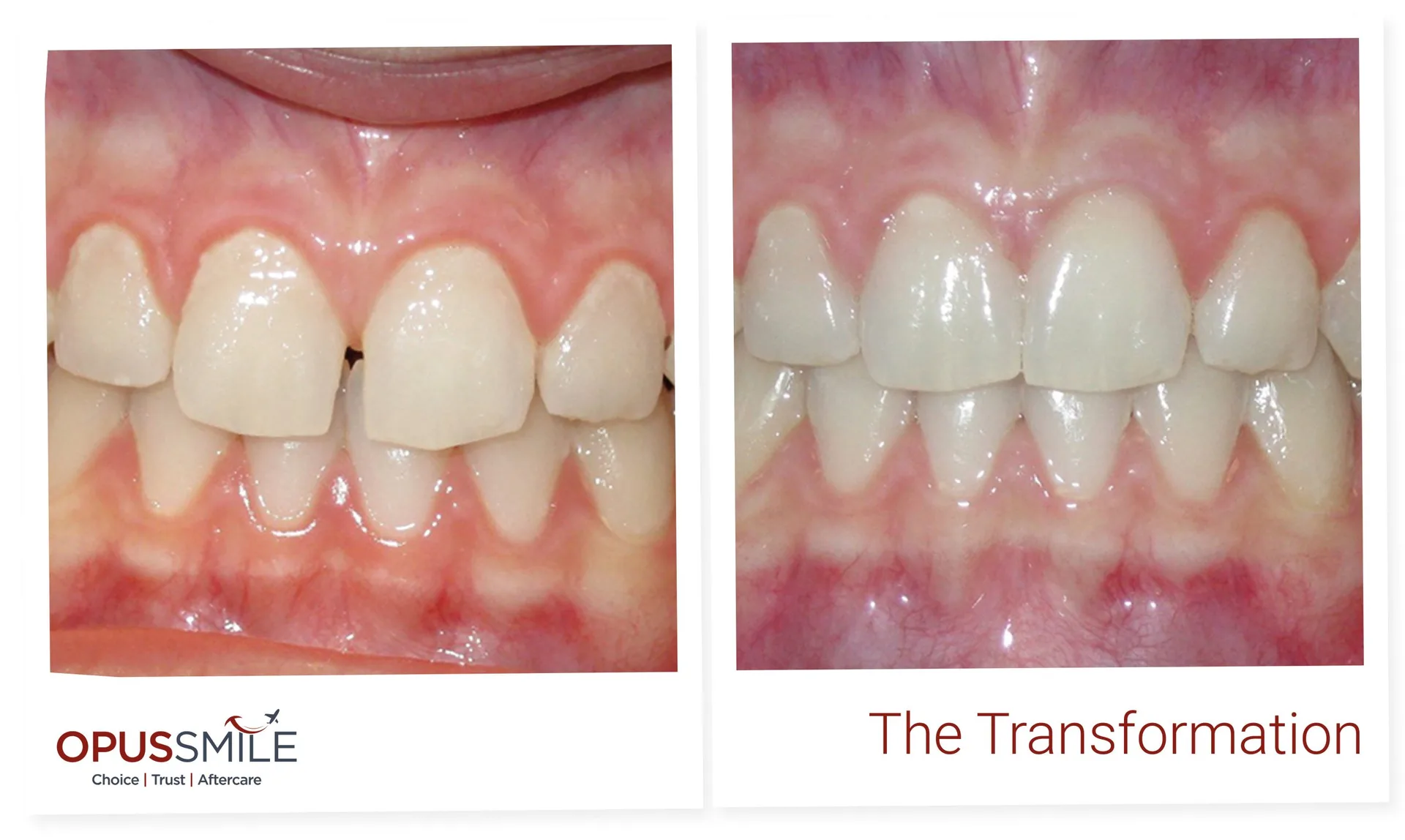
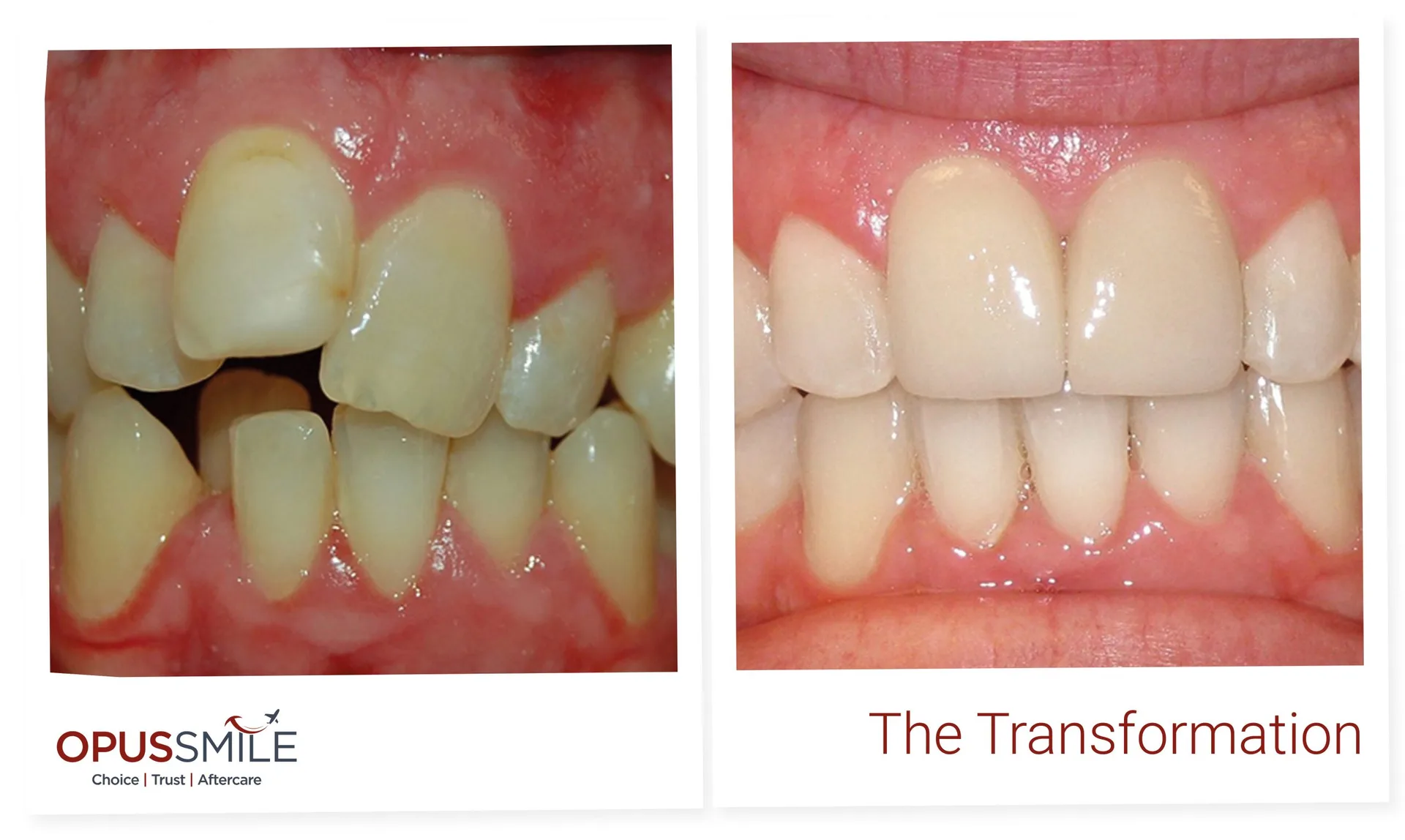
The record
Before & After Photos
05
Living with aligners day to day
You take them out to eat and drink anything other than water, then brush and put them back. That is the routine, and it is the whole of it. Twenty to twenty-two hours a day means they are out for meals and in for everything else.
Each new tray feels tight for a day - that is the tooth being asked to move. Speech is slightly odd for the first few days and then your tongue stops noticing. The genuine inconvenience is social: you cannot graze through a coffee morning without taking them out and cleaning up afterwards.
06
Attachments and IPR explained
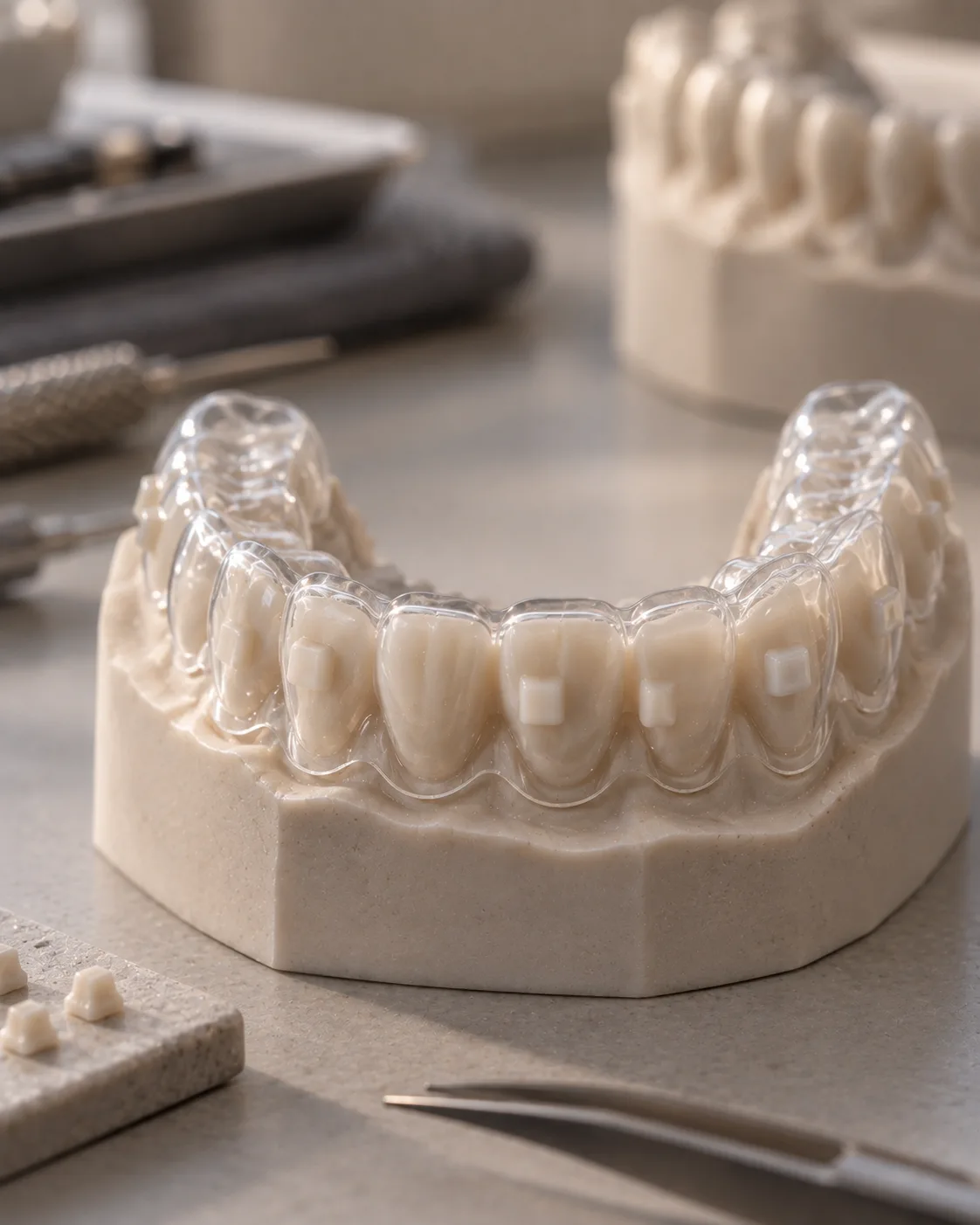
Attachments are small tooth-coloured bumps bonded to certain teeth. The tray grips them so it can push or rotate rather than just slide. They are removed at the end and the tooth is untouched underneath.
IPR - interproximal reduction - is polishing a fraction of a millimetre from between teeth to make room for crowding to unwind. It is measured in tenths, it is painless, and it is the alternative to taking a tooth out.
Both should appear on your plan before you agree to it. If neither is mentioned anywhere, the plan is probably not detailed enough to trust.
07
Do straightened teeth stay straight?
Only if you retain them. Teeth have a memory and they drift back toward where they started, which is why so many adults are treating the same crowding twice.
Retainers are not optional and they are not temporary. Nightly for life is the realistic answer, and a retainer is far cheaper than a second course of treatment.
08
What aligners ask of you
20–22 hours a day, every day, for the whole course.
Out to eat or drink anything but water; brush before they go back in.
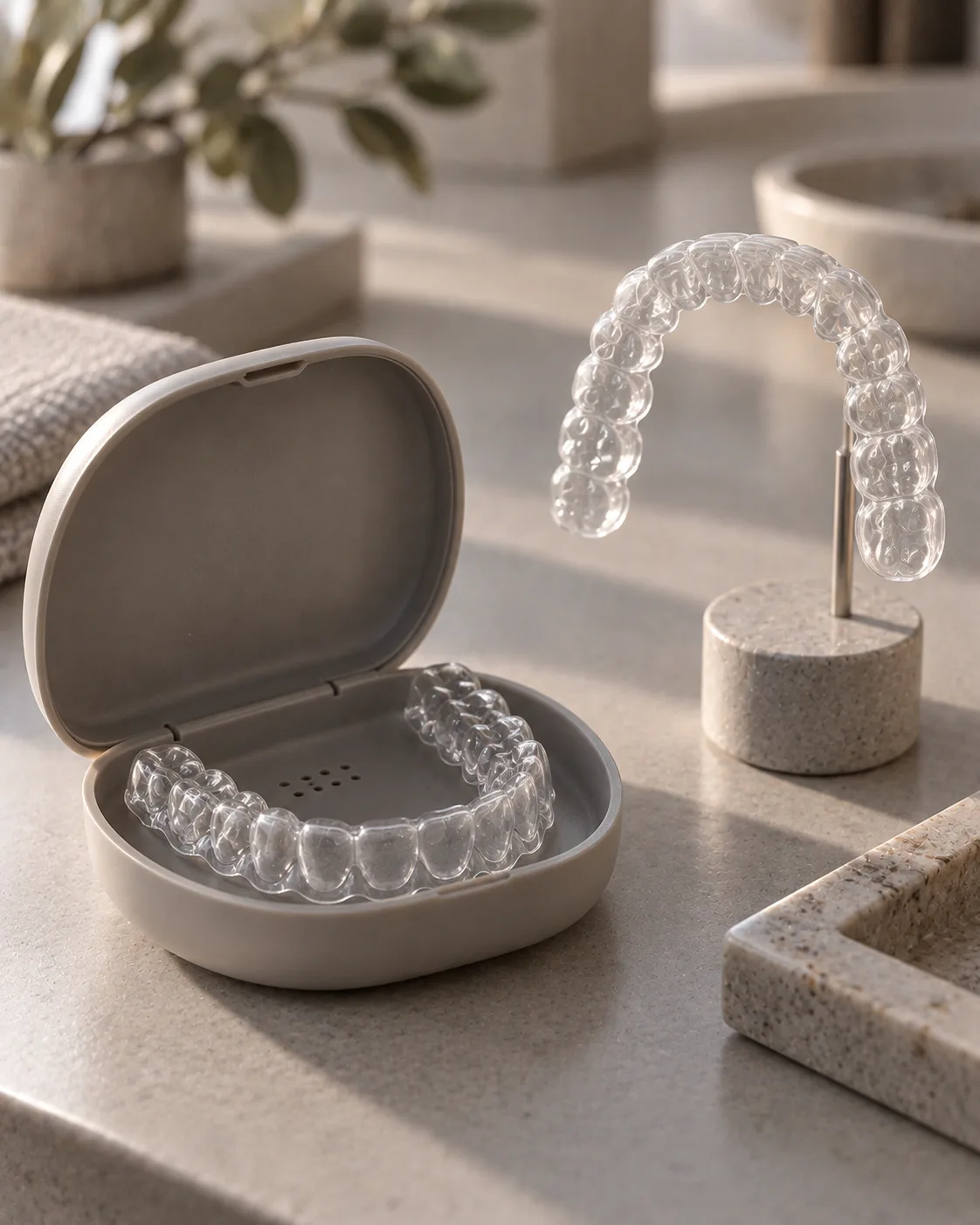
Rinse the trays and keep them in the case, not in a napkin.
Retainers nightly once the course is finished.
Aligners fail on wear time far more often than on planning. If you know that routine will not survive contact with your life, fixed braces are the more honest choice and we would rather say so now.
09
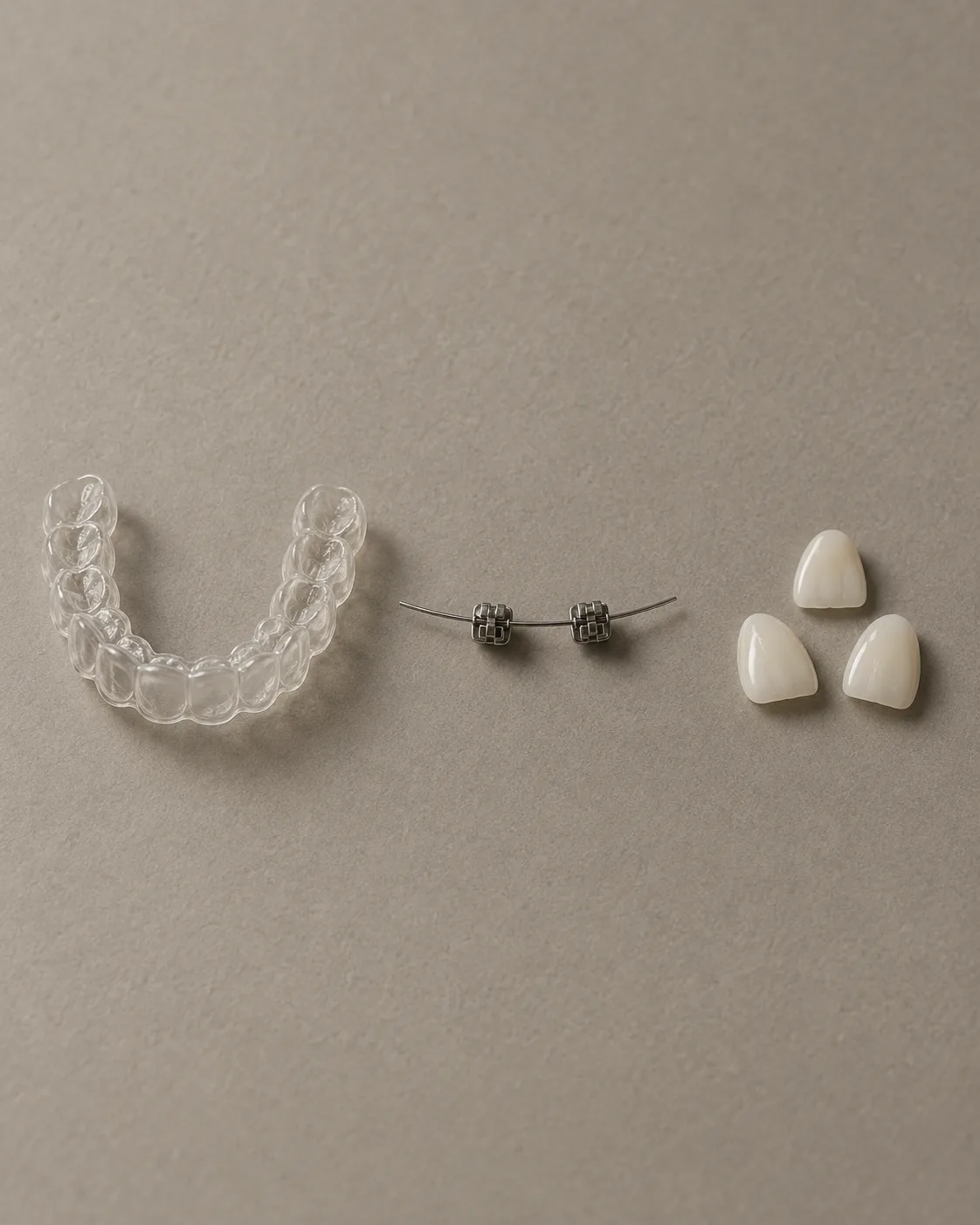
Aligners vs fixed braces vs veneers
Fixed braces handle severe cases and take the discipline out of it, because they are not removable. Less discreet, harder to clean, and still the right tool for complex movement.
Veneers at £210 a tooth change how teeth look in weeks rather than months, but they remove enamel permanently and do nothing about the bite. "Instant orthodontics" is the marketing name for it, and it is a poor trade on healthy teeth.
Aligners move the actual teeth without taking anything away. Slower and dependent on you, and for the right case the best answer available.
Scan, plan and trays
How your aligners are designed and made
Clear aligners are a series of thin, clear trays, each one moving your teeth a fraction further than the last. The whole movement is planned on a scan before the first tray is made, and every tray is made for your teeth alone. This is what goes into it.
01
The scan and the plan
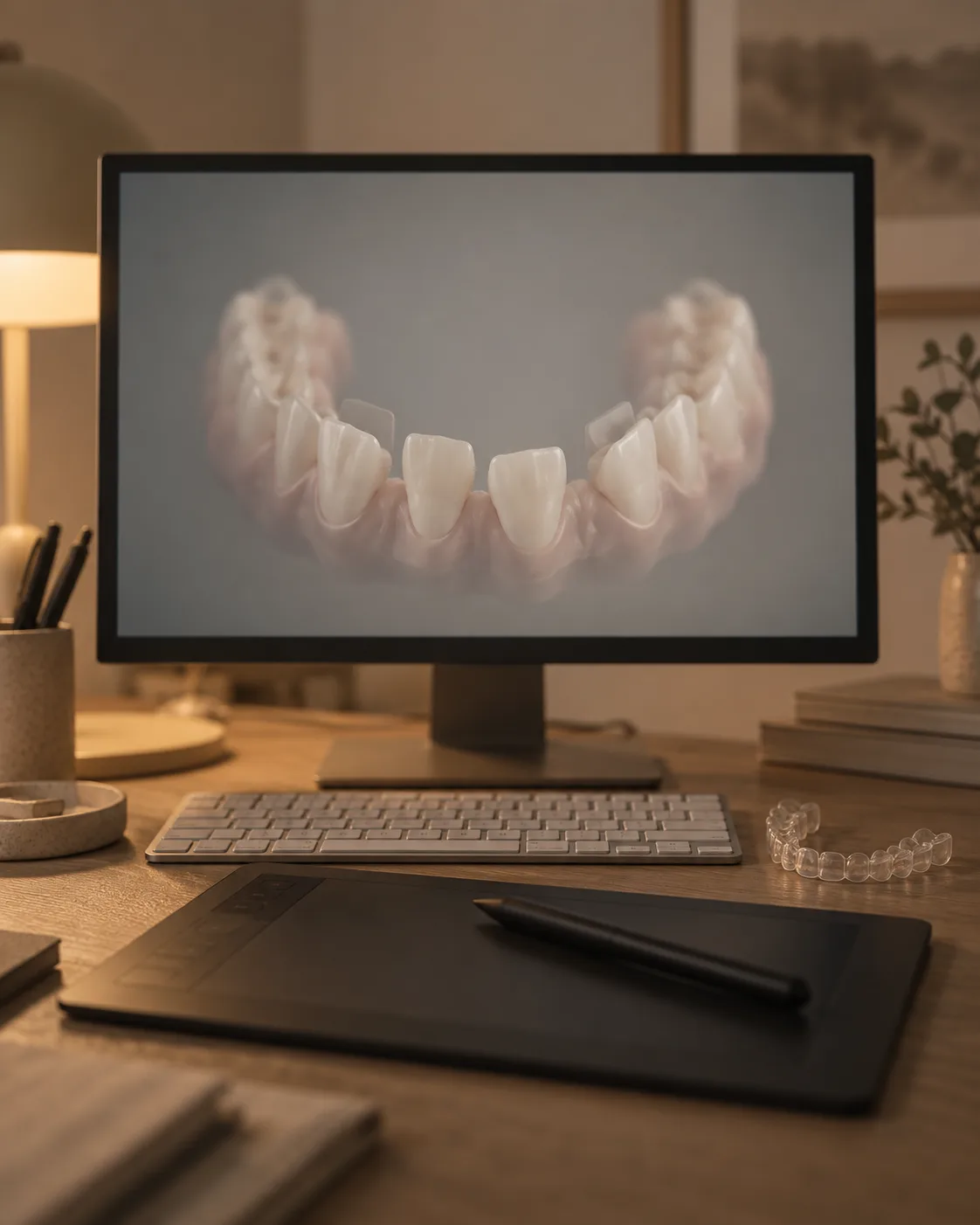
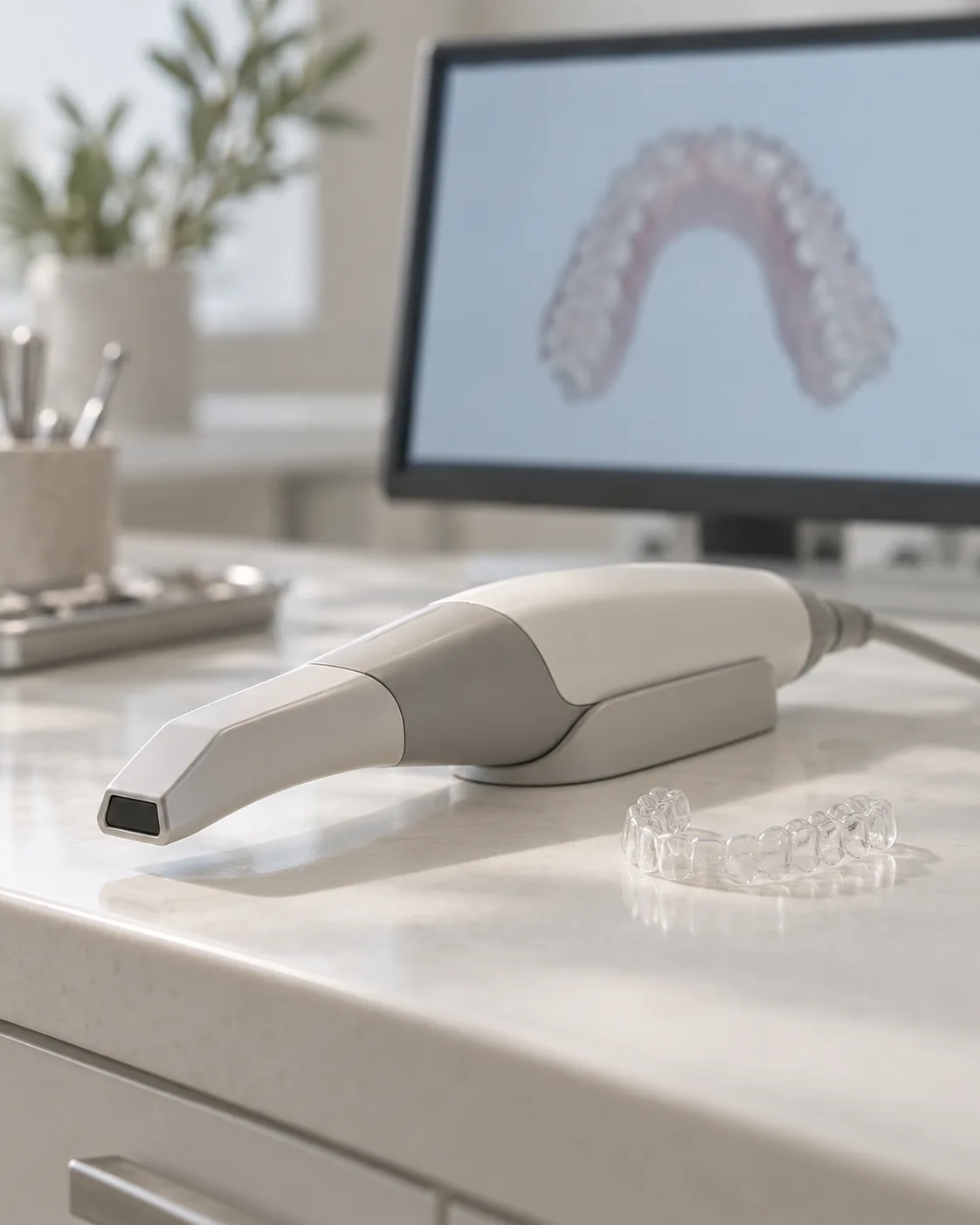
A digital scan of your teeth takes a few minutes and replaces the trays of putty. On screen, the clinician moves each tooth to where it should end up and the software divides that journey into stages, one tray each. You see the finished position before you agree to anything.
02
Attachments and the small adjustments
Some movements need a grip. Small tooth-coloured bumps of composite are bonded to a few teeth so the tray can push and turn them; they come off at the end. Where teeth are crowded, a fraction of a millimetre may be polished from between them to make room.
03
The trays
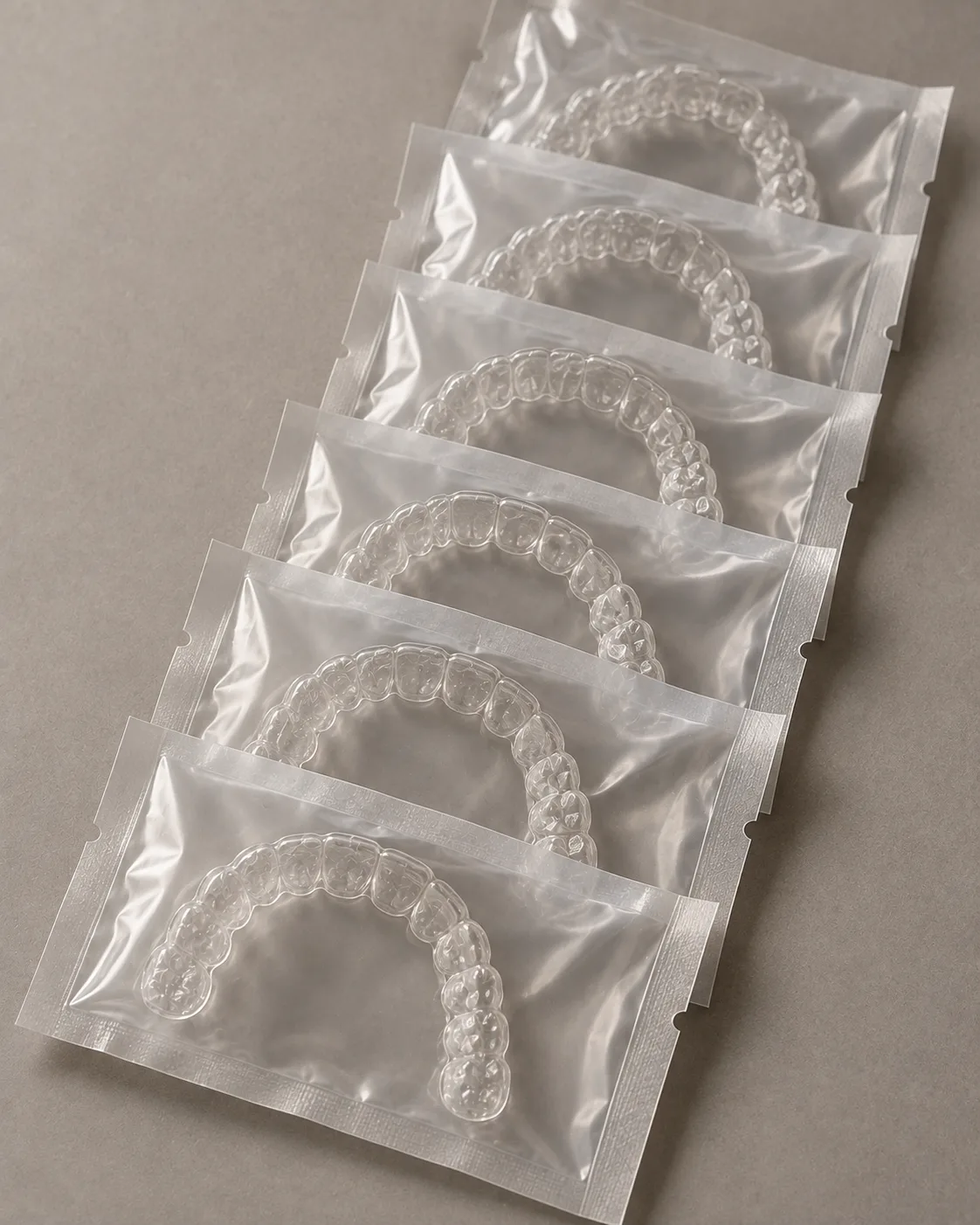
Each tray is worn for about a week, twenty-two hours a day, then swapped for the next. A full course is anywhere from a few months to eighteen months, and the trays come home with you in numbered sets so the treatment carries on between visits.
04
Aligners or braces
Aligners are not right for every case. Where teeth need to move a long way or rotate hard, fixed braces still do it better, and the plan says so honestly.
Option
What it is
How it behaves
Best for
Clear aligners
Removable clear trays, changed weekly.
Nearly invisible; out for eating and brushing; need discipline to wear.
Mild to moderate crowding, spacing and relapse after earlier braces.
Ceramic braces
Fixed tooth-coloured brackets and a wire.
Less visible than metal, a little bulkier, cannot be forgotten.
Bigger movements where looks still matter.
Metal braces
Fixed steel brackets and a wire.
The most control over every movement; the most visible.
Complex cases and large rotations.
Retainers
A thin clear tray or a fixed wire behind the teeth.
Holds the result; worn at night for as long as you want it kept.
Everyone, after any of the above.
Six steps from scan to tray
How each tray is made
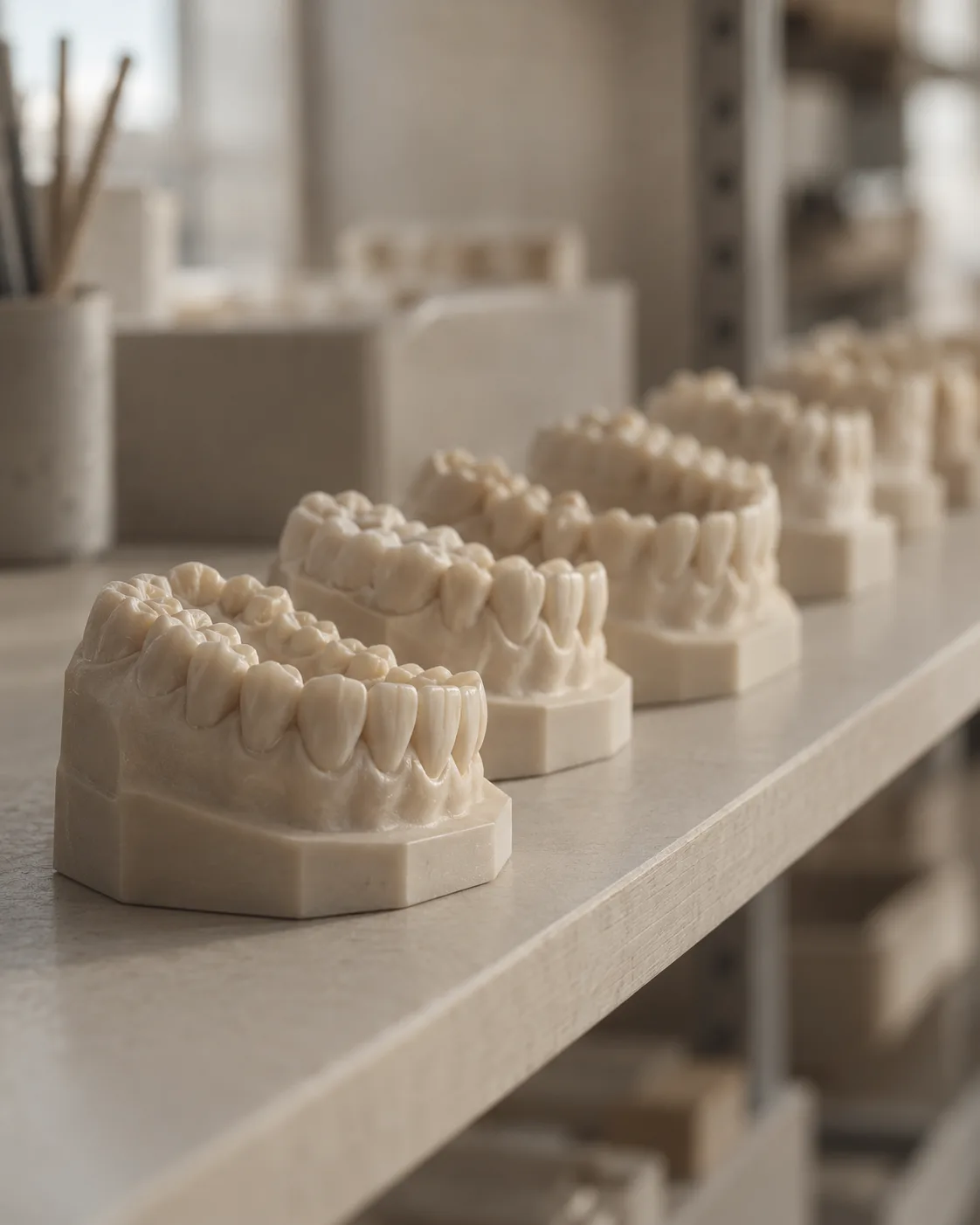
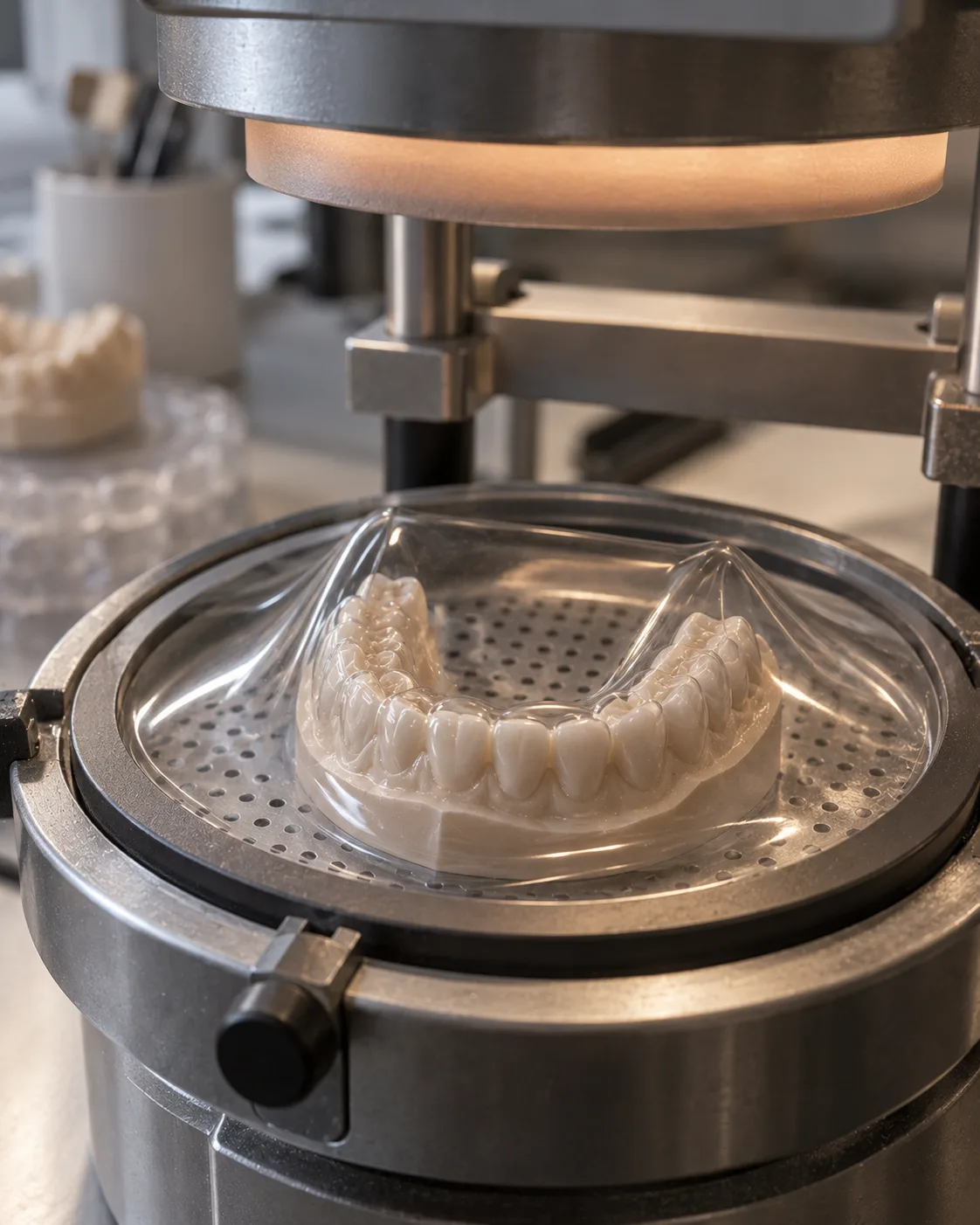
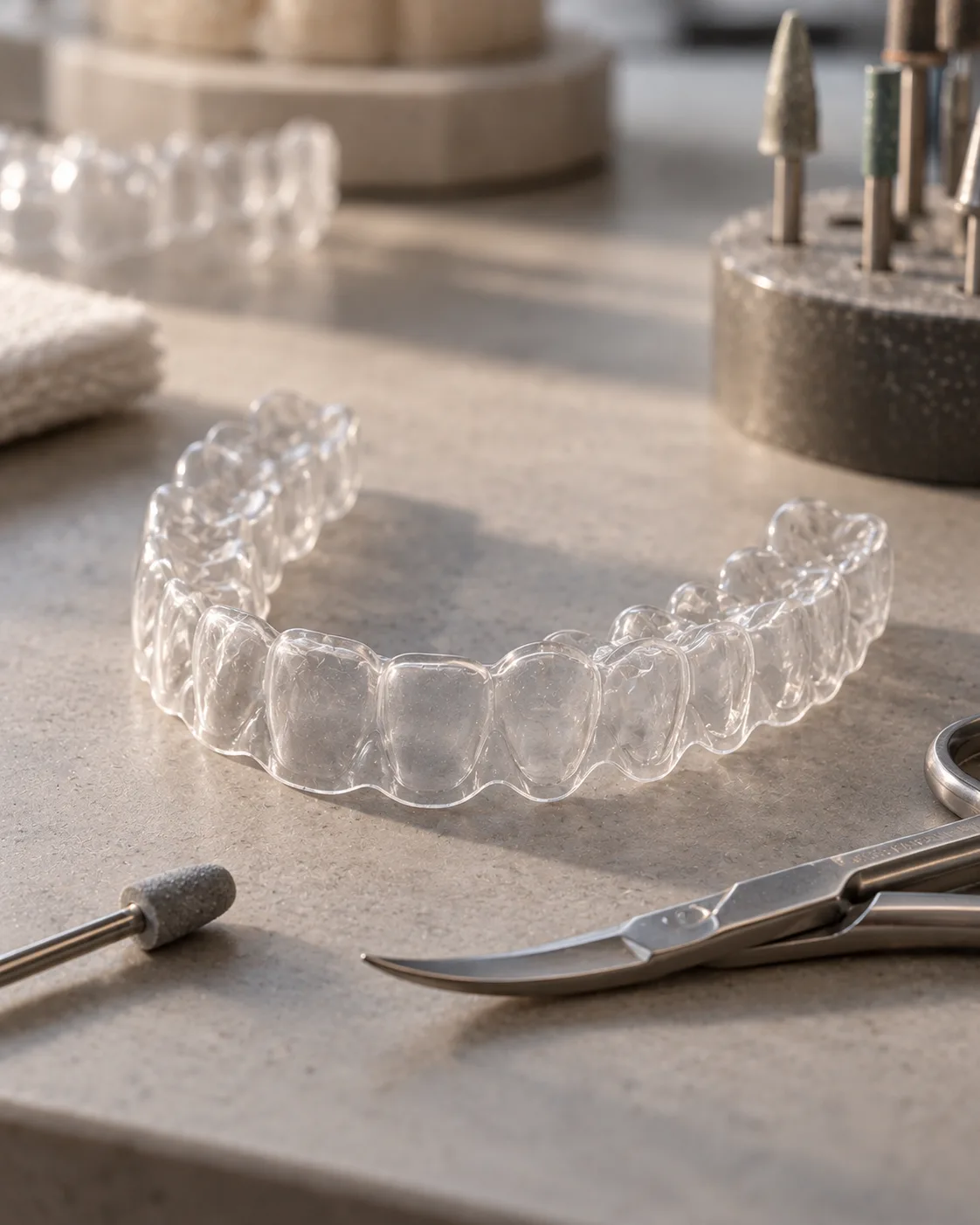
Every tray starts as a printed model of your teeth at one stage of the plan. Machines do the printing and the pressing; a technician trims and checks each one by hand.
01The scanYour teeth are scanned in a few minutes and the model goes straight to the planning software.
02The modelsA resin model is 3D-printed for every stage of the plan, each a fraction further along than the last.
03PressingA sheet of clear plastic is heated and pressed over each model to take its exact shape.
04TrimmingEach tray is cut to the gum line, smoothed and polished so nothing catches your lip.
05The fitThe first tray is fitted and any attachments are bonded on; you leave with the next sets.
06RetainersWhen the last tray is done, retainers are made from a fresh scan to hold the result.
Answered plainly
Clear aligners: your questions answered
Still not sure? A clinician talks it through before you commit to anything.
A few months for mild crowding, twelve to eighteen for a more involved case. The plan gives you the number of trays before you start.
Do aligners hurt?
Tight and slightly tender for a day with each new tray, which is the tooth moving. Not painful, and it fades.
Can people see them?
Barely. Attachments are the visible part up close, and they are tooth-coloured.
What if I lose a tray?
Go back to the previous one and message your patient manager. Do not skip ahead - the next tray will not fit teeth that have not made the previous move.
Can I have aligners if I have crowns or veneers?
Usually. Attachments do not bond as reliably to porcelain, so the plan works around them. Tell us what is already in your mouth at the assessment.
Should I straighten before veneers?
Almost always. Moving a tooth costs no enamel; disguising it does. It also usually means fewer veneers at the end.
Do I really have to wear retainers forever?
Yes, nightly. Teeth drift for life. This is the single most common reason people need treatment a second time.
Can I whiten while I am in aligners?
Yes, and the trays make a convenient vehicle for it. Whitening is £200 a course.
Are aligners available on the NHS?
Not for adults in any routine way. NHS orthodontics is largely restricted to under-18s with clear clinical need.
Why choose us
Why Choose Opus Smile for Aligners
01UK-backed clear aligner care
02Near-invisible straightening
03Safe, clear, modern
Our focus is your result. We set clear expectations, give honest guidance, and support you from first message to final retainers. Every partner clinic is vetted for safety, outcomes, and patient experience. Your aligner plan is digitally designed around your bite and goals, using named, traceable materials.
You keep the best of both worlds: significant savings versus typical UK private fees plus a written warranty and UK-based aftercare. No bait pricing. No pressure. We assess first, explain options, and confirm exact costs only after proper diagnostics.
Tell us what you need. We will price it in writing.
One message and a coordinator replies with an indicative plan and price. Send a photograph of your smile if you have one - it makes the answer better, and it is never a call unless you ask for one.
We use a few cookies to keep the site working - your language, your currency, and your
session if you are signed in. Those are always on because the site cannot work without them.
We would also like to use one that measures how people find us and pays us a commission
on travel booked through the site. That one is entirely your call.
Read the privacy policy.